The Rosemary you don't know
You think you know Rosemary (Rosmarinus officinalis). You might use it in cooking, or have seen it growing in neat Provençal gardens. But Corsican Rosemary is not the same.
Growing freely on the sunny southern slopes of the Corsican maquis, buffeted by the wind and scorched by the summer sun, Corsican Rosemary develops a specific chemotype — the camphor chemotype — which gives it circulatory and toning properties that other varieties do not achieve.
In Corsica, it is not cultivated. It grows where it wants, when it wants. It is hand-picked, respecting its cycles, never taking more than the plant can regenerate. It is this freedom that makes it an exceptional active ingredient.
The Corsican chemotype — a unique signature
In botany, a chemotype refers to a variety of the same plant that produces a different biochemical composition depending on its environment. Soil, climate, altitude, sun exposure — all of this shapes the intimate chemistry of the plant.
Corsican Rosemary produces a camphor chemotype — a high concentration of camphor and 1,8-cineole — which gives it a radically different action profile from verbenone rosemary (which is rather hepatoprotective) or borneone rosemary.
This chemotype is the most active on blood and lymphatic circulation. This is why it is the Rosemary of body care — draining, toning, stimulating.
Its cosmetic properties
Circulatory stimulation The camphor and 1,8-cineole in Corsican Rosemary are powerful circulatory stimulants. They activate cutaneous microcirculation, promote cellular exchange and bring warmth and vitality to tissues. The skin regains its tone and natural radiance.
Lymphatic drainage Its action on the lymphatic system is particularly well-documented. Camphor chemotype Rosemary promotes the elimination of metabolic waste and reduces water retention — a choice active ingredient for treatments targeting cellulite and heavy legs.
Muscle toning Used in massage, it relaxes tired muscles while toning them — a rare combination that explains its traditional use by athletes in recovery.
Antioxidant action Rosmarinic acid — one of the most powerful antioxidants in the plant kingdom — is present in high concentration in Corsican Rosemary. It neutralizes free radicals, protects cells from oxidative stress and slows down premature skin aging.
Purification & balance Its natural antiseptic action purifies the skin and regulates the cutaneous microbiota. It is particularly effective on acne-prone skin that needs deep cleansing without aggression.
A plant rooted in the history of Corsica
Rosemary has accompanied the history of Corsica for millennia. Corsicans traditionally used it for its medicinal virtues — stimulating, tonic, purifying. Its silvery and fragrant spots mark the landscape of the maquis, visible from hiking trails to coastal cliffs.
By choosing it as an active ingredient, we are not just selecting an effective plant. We are perpetuating ancestral knowledge, we are anchoring our formulas in the history of a territory and a people.
In our products
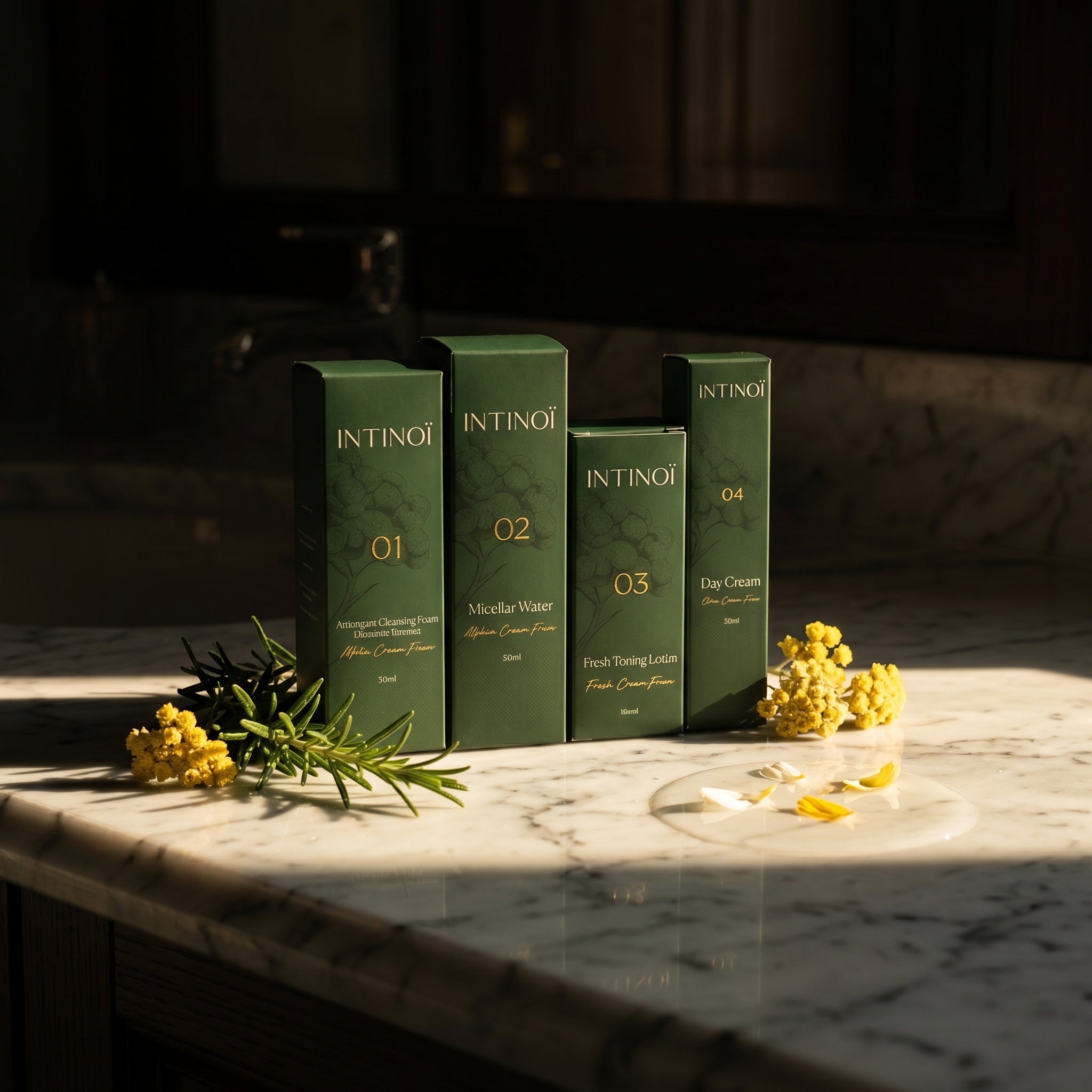
Rosemary is one of the 5 hydrolats in our Purifying Astringent Mousse n°1 — the Synergy 5 Hydrolats — where it contributes to the purifying and antioxidant action of the formula. It is also present in our Radiance Toning Lotion P3 for its antioxidant action and its brightening effect on the complexion.
"Corsican Rosemary smells of the maquis warmed by the sun — and acts like a wake-up call for tissues."